Archive
REVIEW – The Addams Family
 Directed by: Barry Sonnenfeld

Produced by: Scott Rudin
Written by: Caroline Thompson, Larry Wilson
Edited by: Dede Allen
Cinematography by: Owen Roizman
Music by: Marc Shaiman
Starring: Anjelica Huston, Raúl Juliá, Christopher Lloyd, Christina Ricci, Jimmy Workman, Judith Malina, Carel Struycken, Elizabeth Wilson, Dan Hedaya, Dana Ivey, Paul Benedict, John Franklin, Christopher Hart(’s hand)
Based on The Addams Family comics by Charles Addams
Year: 1991
“And you thought your family was weird! Meet… the Addams Family!”
… You can practically imagine what kind of crappy trailer and taglines could be written for this film adaptation of Charles Addams’ comic strip. Released on the same day as Disney’s Beauty and the Beast, though the film is undoubtedly going for a different audience, it’s still impressive that the film was as successful as it was, given that fact. Critics generally enjoyed it, audiences loved it (forking over $191.5 million worldwide against a $30 million budget), and the film led to a resurgence in the brand, spawning an acclaimed sequel, an animated series, and – heck – even one of the most successful pinball machines ever made. Heck, it was even Barry Sonnenfeld’s first film as director, leading to such acclaimed hits as Men in Black, Get Shorty, and… Wild Wild West… Nine Lives… Well, you can’t win ‘em all, but still. Read more…
REVIEW – It (2017)
 Directed by: Andy Muschietti

Produced by: Roy Lee, Dan Lin, Seth Grahame-Smith, David Katzenberg, Barbara Muschietti
Screenplay by: Chase Palmer, Cary Fukunaga, Gary Dauberman
Edited by: Jason Ballantine
Cinematography by: Chung-hoon Chung
Music by: Benjamin Wallfisch
Starring: Jaeden Lieberher, Bill Skarsgård, Sophia Lillis, Jeremy Ray Taylor, Finn Wolfhard, Wyatt Oleff, Chosen Jacobs, Jack Dylan Grazer, Nicholas Hamilton, Owen Teague, Stephen Bogaert, Jackson Robert Scott
Based on the novel It by Stephen King
Year: 2017
I always seem to preface these types of reviews with this, but it bears remarking again: Horror remakes are rarely successful and rarely a good idea, and the trailers for this 2017 adaptation of Stephen King’s novel about a transdimensional being taking on the form of a malevolent clown who terrorizes children was looking to be just one more film on the pile of crappy remakes, reboots, and reimaginings we’ve been getting since the turn of the century. The emphasis on jump scares, the hammered-into-your-brain catchphrases, creepy horror children, and the audacity to challenge the immortal Tim Curry’s portrayal from the miniseries with a gritty new take on the clown really didn’t work in the film’s favor. This was particularly worrisome, as the film with the film had been in development hell for approximately six years due to creative conflicts before finally moving forward in production in its final form, releasing two years after that. As someone who had never seen the cheesy 3-hour-long miniseries, let alone read the 1000+ page novel, however, I was at least open to the idea that this could at least provide an easy gateway into a cultural touchstone I really had little prior interest in touching myself. Turns out…I was totally right, but not in the way I thought. Read more…
REVIEW – Good Time
 Directed by: Ben Safdie, Josh Safdie
Produced by: Sebastian Bear-McClard, Oscar Boyson, Terry Dougas, Paris Kasidokostas Latsis
Written by: Josh Safdie, Ronald Bronstein
Edited by: Ben Safdie, Ronald Bronstein
Cinematography by: Sean Price Williams
Music by: Oneohtrix Point Never
Starring: Robert Pattinson, Jennifer Jason Leigh, Ben Safdie, Barkhad Abdi, Buddy Duress, Taliah Webster
Year: 2017
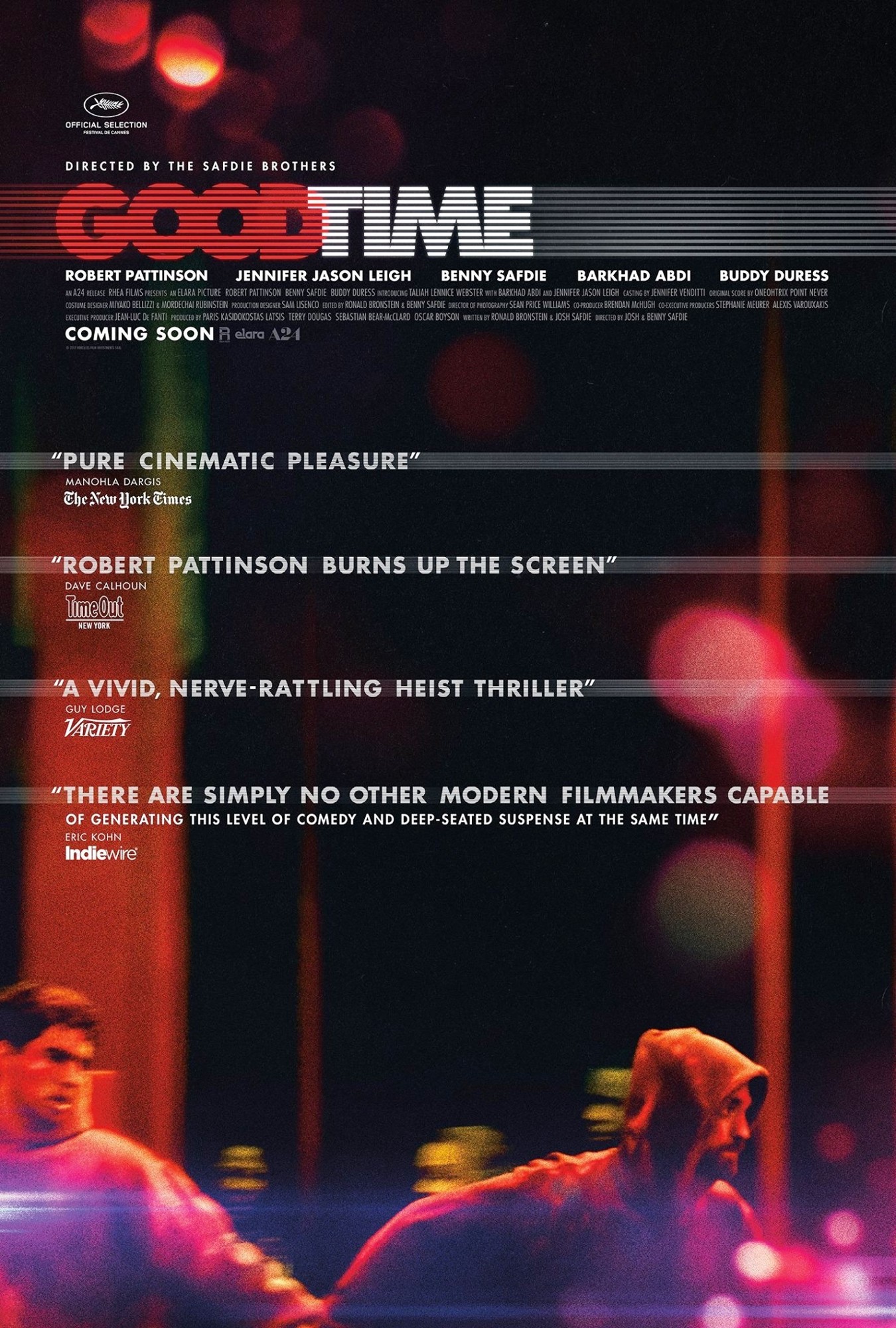
From the ominous ‘80s-style synth score, the splashes of neon-drenched cinematography, to the exclamations of praise for star Robert Pattinson, I knew from the trailers that Good Time was a film I wanted to experience in the theatre but which I was certain would open locally exclusively in the more expensive theatre that charged double for luxury seating and the privilege of seeing something non-mainstream. Imagine my surprise when this indie thriller instead opened in the mainstream theatres, making the experience so much more affordable. Now imagine my lack of surprise when I ended up being the only one at that screening. (I mean, sure, it was a Monday night, but still….) Even with the rave reviews and a Twilight star in the lead role, Good Time was always going to be a hard sell to mainstream audiences, but that doesn’t mean you, discerning and intelligent reader, should ignore what I think is probably one of the more compelling films I’ve seen so far in 2017. Read more…
REVIEW – Brokeback Mountain
 Directed by: Ang Lee

Produced by: Diana Ossana, James Schamus
Screenplay by: Larry McMurtry, Diana Ossana
Edited by: Geraldine Peroni, Dylan Tichenor
Cinematography by: Rodrigo Prieto
Music by: Gustavo Santaolalla
Starring: Heath Ledger, Jake Gyllenaal, Michelle Williams, Anne Hathaway, Linda Cardellini, Randy Quaid, Kate Mara
Based on the 1997 short story by Annie Proulx
Year: 2005
It’s been 12 years since the release of the film dubbed “The Gay Cowboy Movie” was released, and yet Brokeback Mountain still arguably remains the most recognized film about a same-sex romance in the public mind. Though several films have come out since representing LGBTQ people (the incredible Moonlight is probably the most recent to gain the national spotlight, even though it was largely thanks to its near exclusion from said spotlight at the Oscars), but none have yet to have the same kind of cultural impact as this 2005 release. I think it’s safe to say that the film was a milestone, regardless of whether you actually saw it or not. The film’s release created a minefield of various controversies on all sides of “the gay issue,” and the concept alone of usually rugged character types falling in love with one another led to the film becoming a cultural phenomenon. Predictably, detractors accused the film of “pushing the gay agenda down our throats,” and it was also outright banned from showing in certain countries. The term “brokeback” entered the public lexicon as a word synonymous with “on the down-low,” usually used humorously in moments of gay panic. Supporters of the film couldn’t escape the outrage machine, either, accusing the Academy Awards of homophobia when the film famously lost its Best Picture nomination to the allegedly inferior and heavy-handed morality play Crash. They even accused the marketing of similar shenanigans when any scenes of romance between the two cowboys was deemphasized or just outright excluded from ads – again, despite it widely being known as “The Gay Cowboy Movie.” The cultural impact of the film cannot be denied, but I think even supporters lose sight of what is arguably more important: that Brokeback Mountain is arguably one the best romantic films ever made. Read more…
REVIEW – Ewoks: The Battle for Endor
 Directed by: Jim Wheat, Ken Wheat

Produced by: Thomas G. Smith, Ian Bryce
Screenplay by: Jim Wheat, Ken Wheat
Story by: George Lucas
Edited by: Eric Jenkins
Cinematography by: Isidore Mankofsky
Music by: Peter Bernstein, John Williams (themes)
Starring: Wilford Brimley, Warwick Davis, Aubree Miller, Siân Phillips, Paul Gleason, Carel Struycken, Niki Botelho, Eric Walker, Daniel Frishman, Tony Cox, Pam Grizz, Roger Johnson
Year: 1985
Well, they talk now… Or, at least, Wicket does. And by “talk,” I of course mean “speaks English” – or, if you will, “speaks Galactic basic” – rather than just Ewokese. Released a year after the first Ewok-starring Star Wars spinoff, Caravan of Courage, and set months after the events of that film, The Battle for Endor sees the friendship between Cindel Towani and Wicket the Ewok blossoming, to the point where Cindel’s lessons from the first film have apparently paid off. But, sadly, the Towanis have also made progress in repairing their star cruiser since being rescued from the Gorax by Cindel, her brother Mace, and the Ewoks, and so it’s almost time for them to go back home and say good-bye to their furry friends. Read more…
REVIEW – Wonder Woman
 Directed by: Patty Jenkins
Produced by: Charles Roven, Deborah Snyder, Zack Snyder, Richard Suckle
Screenplay by: Allan Heinberg
Story by: Zack Snyder, Allan Heinberg, Jason Fuchs
Edited by: Martin Walsh
Cinematography by: Matthew Jensen
Music by: Rupert Gregson-Williams
Starring: Gal Gadot, Chris Pine, Robin Wright, Danny Huston, David Thewlis, Saïd Taghmaoui, Ewen Bremner, Eugene Brave Rock, Connie Nielsen, Elena Anaya, Lucy Davis
Based on DC Comics characters created by William Moulton Marston
Year: 2017
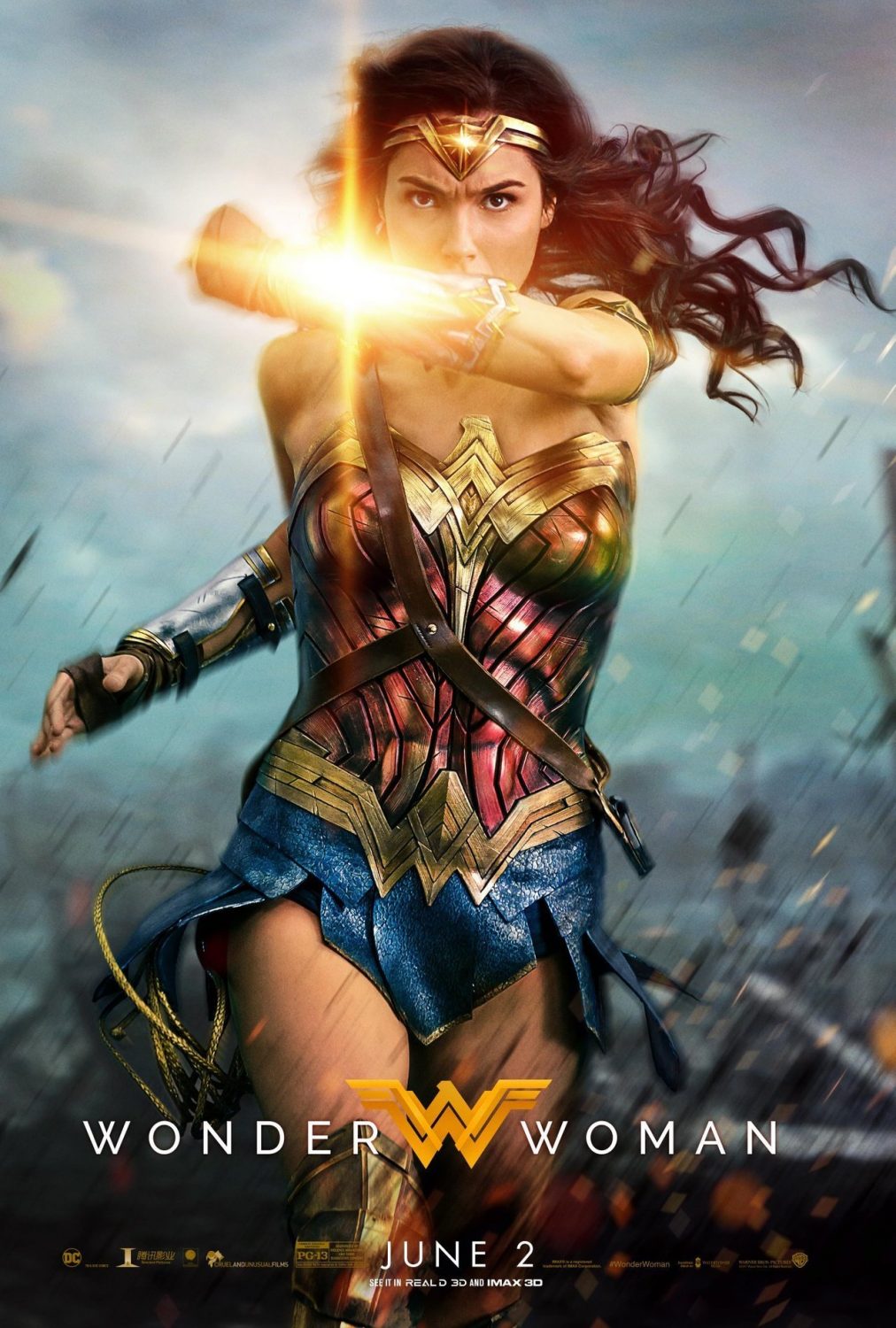
Seventy-five and a half years. That’s how long it has taken for Wonder Woman to finally get herself a film of her own. Twelve years. That’s how long it’s been since the release of Elektra, the last major superhero film starring just a major female superhero in the lead role and not as part of a team of predominantly male heroes. Five. That’s the number of films I count from Wikipedia’s list of superhero films since 1920 that have starred solely a female lead: Supergirl (1981), Tank Girl (1995), Barb Wire (1996), Catwoman (2004), and Elektra (2005). It’s six only if you count the TV movie Witchblade (2000), which acted more like an extended pilot episode. While comic books have always had their own struggles with female representation, film adaptations (and even some original works) have always seemingly struggled more, largely because a lot more is riding on them ($$$). For some reason, executives just never really saw these properties as being as marketable (i.e., profitable) as their male counterparts, and it seems as though the aforementioned films have stood as evidence of why that is the case, both in the execs’ eyes and, sadly, in the eyes of many in the general audience. Read more…
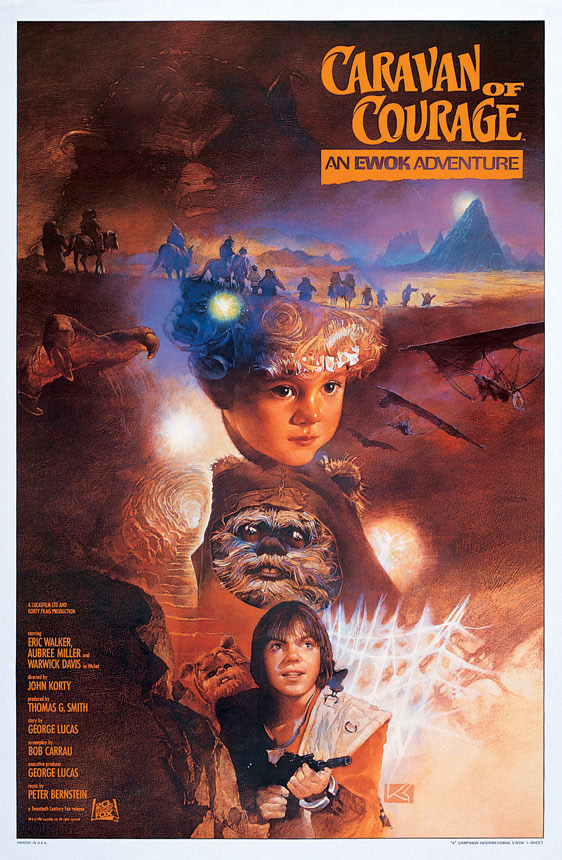
REVIEW – Caravan of Courage: An Ewok Adventure
 Directed by: John Korty
Produced by: Thomas G. Smith
Screenplay by: Bob Carrau
Story by: George Lucas
Edited by: John Nutt
Cinematography by: John Korty
Music by: Peter Bernstein, John Williams (themes)
Starring: Eric Walker, Warwick Davis, Aubree Miller, Daniel Frishman, Debbie Lee Carrington, Tony Cox, Kevin Thompson, Margarita Fernández, Pam Grizz, Bobby Bell, Fionnula Flanagan, Guy Boyd, Darryl Henriques (voice), Sydney Walker (voice), Burl Ives (narration)
Originally known as: The Ewok Adventure
Year: 1984
What happens when you’ve seemingly brought an end to one of the most profitable film sagas, and yet you still want to make money off of the property in a similar medium? Why, you make a spin-off, of course! Return of the Jedi had brought the original film trilogy to a close on its release on May 25, 1983, but George Lucas was obviously far from finished with the series, despite this. (And who can complain, really?) Even before the concept of the prequel trilogy was thought up, and well before Disney’s acquisition and foray into the sequels and their own spinoffs, there were already plans to expand the series beyond the core films and even into the realm of television – just, you know, not in the form of a variety show. The Star Wars Holiday Special was considered to be an embarrassment by almost all involved, including George Lucas. So when this project began to move forward, Lucas ensured he had full creative control. Read more…
REVIEW – Alien: Covenant
 Directed by: Ridley Scott

Produced by: Ridley Scott, Mark Huffam, Michael Schaefer, David Giler, Walter Hill
Screenplay by: John Logan, Dante Harper
Story by: Jack Paglen, Michael Green
Edited by: Pietro Scalia
Cinematography by: Dariusz Wolski
Music by: Jed Kurzel
Starring: Michael Fassbender, Katherine Waterston, Billy Crudup, Danny McBride, Carmen Ejogo, Demián Bichir, Amy Seimetz, Jussie Smollett, Callie Hernandez, Nathaniel Dean, Alexander England, Benjamin Rigby
Year: 2017
Alien: Covenant has a lot to live up to. Not only does it have to one-up a film that has largely come to be known as (inexplicably) a reviled film, Prometheus, but it must also bridge the gap between that film and one of the more widely respected sci-fi films ever made, Alien, just by taking on a more direct title, thus negating any “it’s just a side story” hand waving should it fail to live up to the standard of the first two films. Personally, I’m with everyone else in considering Alien and Aliens to be masterpieces, but I also think that the hate reserved for Alien 3 and Prometheus is largely overblown, too. (Resurrection and the AvP films can pretty much just go to hell, though.) As such, while I was certainly hoping for a masterpiece in Covenant, I also realize that this was probably never going to come to pass, and so I also had my expectations set accordingly – and had a pretty good time as a result, it turns out. Read more…
REVIEW – Guardians of the Galaxy Vol. 2
 Directed by: James Gunn

Produced by: Kevin Feige
Written by: James Gunn
Edited by: Fred Raskin, Craig Wood
Cinematography by: Henry Braham
Music by: Tyler Bates
Starring: Chris Pratt, Zoe Saldana, Dave Bautista, Bradley Cooper, Vin Diesel, Michael Rooker, Karen Gillan, Pom Klementieff, Kurt Russell, Sean Gunn, Elizabeth Debicki, Chriss Sullivan, Sylvester Stallone
Based on characters from Marvel Comics
Year: 2017
The first Guardians of the Galaxy was the little known film that could, becoming an unexpected smash hit with audiences and critics back in 2014 despite possibly being the most obscure and quite literally out-there property to be given a major film by Marvel Studios – or, really, any previous comic book adaptation, save for maybe Howard the Duck, a fact acknowledged by Guardians’ post-credits scene. Say what you will about Phase 1 of the Marvel Cinematic Universe, but while Iron Man, Captain America, and Thor were almost certainly not on the same level as Batman, Superman, and Spider-Man, they weren’t nearly as bizarre in concept as a team that features a talking, gun-toting cybernetic raccoon and his sentient tree companion whose specifically limited vocabulary makes Chewbacca’s system of howls seem plausibly understandable by comparison. Smart marketing and director/writer James Gunn’s keen sense on how to make all this palatable to even mainstream audiences, however, won out, and the film – and even its soundtrack – was, again, a massive success. Naturally, a sequel has been made. Read more…
REVIEW – Mustang
 Directed by: Deniz Gamze Ergüven

Produced by: Charles Gillibert
Written by: Deniz Gamze Ergüven, Alice Winocour
Edited by: Mathilde Van de Moortel
Cinematography by: David Chizallet, Ersin Gok
Music by: Warren Ellis
Starring: Günes Sensoy, Doga Zeynep Doguslu, Tugba Sunguroglu, Elit Iscan, Ilayda Akdogan, Nihal G. Koldas, Ayberk Pekcan, Bahar Kerimoglu, Burak Yigit
Year: 2015
What does it mean to be a young woman in a Muslim community? I obviously cannot answer this myself, being a Christian male who grew up in a predominately Christian culture in America, but it’s nonetheless something that has actually crossed my mind a few times. Needless to say, there are certain stereotypes that exist, particularly (and often ironically) in the minds of non-Muslims, regarding Muslim women. This doesn’t hold up for me, though, as there are always exceptions, and, more importantly, there are also women who should be allowed to tell their own stories about growing up in their own culture without our presuppositions clouding our judgment. You’d think that such a thing wouldn’t be a rarity, given the widespread attention of, for example, Malala Yousafzai, who you may recall was nearly assassinated for her outspoken views on educational rights for women, but the rarity is still sadly the truth. Before I saw the film at the center of this review, the only other one that really came to mind is Haifaa al-Mansour’s 2012 film Wadjda, hailing from Saudi Arabia – a truly great story about a young girl who dreams of owning a bicycle, which is frowned upon for women in their society. Of course, now we have French-Turkish director Deniz Gamze Ergüven’s Mustang, which may not be as overt as Wadjda but is no less eye-opening in terms of the varieties of perspectives so often ignored in order to confirm certain biases. Read more…

 The Viewer's Commentary