Archive
Memorial Day Review: “Wings”
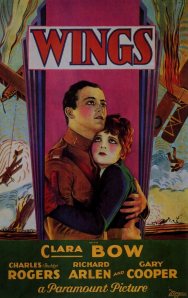 Directed by: William A. Wellman

Produced by: Lucien Hubbard, Adolph Zukor, Jesse L. Lasky, B.P. Schulberg, Otto Hermann Kahn
Written by: Julian Johnson
Edited by: E. Lloyd Sheldon, Lucien Hubbard (uncredited)
Cinematography by: Harry Perry
Music by: J.S. Zamecnik
Starring: Charles “Buddy” Rogers, Richard Arlen, Clara Bow, El Brendel, Jobyna Ralston, Gary Cooper
Year: 1927
It might be hard to believe for many modern audiences, but there was a time when films had to go without dialogue. Strange, I know! “Silent films,” as we’ve come to all them (as I assume they weren’t called that when they were still the norm), weren’t necessarily all silent – they still had a musical recording or live performance to accompany them, and some, such as this one, even had sound effects synced up with the film, albeit usually more for ambiance than anything. By the time that Wings had been released, the more accurately named “talkies” were already in production, with the first feature length film with synchronized dialogue, The Jazz Singer, was released just months after Wings’ theatrical debut. If you’ve at the very least seen Singin’ in the Rain, you know what kind of impact The Jazz Singer had on filmmaking. Read more…
SCARY MOVIE MONTH – Watch “The Cabinet of Dr. Caligari” (1920)
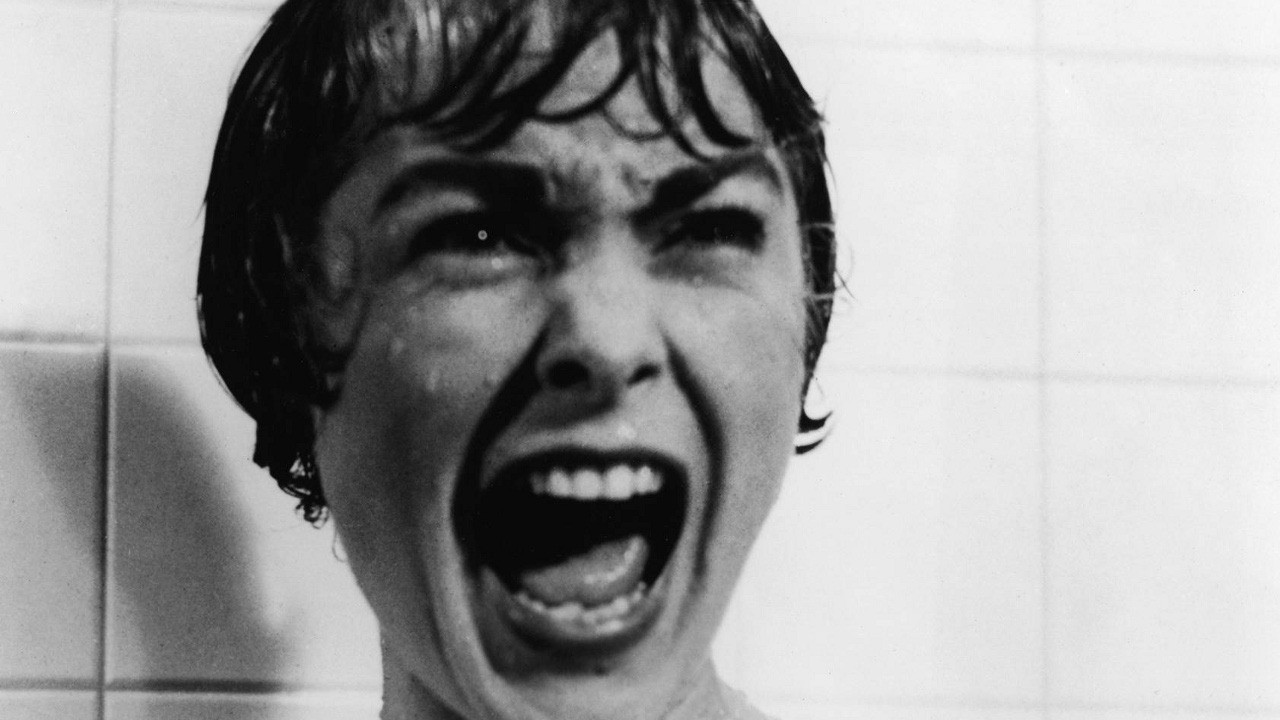
It’s that time again! Halloween is coming up, and so it’s time for scary movies! Last year, I wound up focusing a great deal on classic slasher films, with a few other sub-genres thrown in for good measure. For your convenience, I’m including a link to all the scary movie reviews I wrote right here, in order:
Saw
The Last House on the Left (1972)
Contagion
The Last House on the Left (2009)
Friday the 13th (1980)
Sleepy Hollow
A Nightmare on Elm Street (1984)
Halloween (1978)
A Nightmare on Elm Street 3: Dream Warriors
Wes Craven’s New Nightmare
A Nightmare on Elm Street (2010)
28 Days Later
Shaun of the Dead
I list these because, as you can see, it’s a lot of slashers, sequels, and remakes, with Contagion being arguably the only odd duck, as it is a scary movie, but not necessarily horror. I felt it necessary at the time to explore these slashers, largely because they were films I wasn’t that familiar with. I didn’t particularly enjoy watching all of these grouped together, but I did enjoy the learning experience. This year, however, I’m going to focus more on scary movies that I, personally, enjoy. I intended to review some of these films last year but, for several reasons, did not get around to doing so.
 Seeing as how Halloween is also my birthday, I’m feeling a bit selfish this year, I guess. I’m turning 26, and I’m feeling as though my youth has peaked, and I’m now beginning the downward spiral. Call me dramatic, if you must! So, yeah, you’re mostly going to see reviews of films that I actually do enjoy, though I’ll try to sneak in a few that I don’t as well. You’ll also likely see a few reviews of films that are not scary or horror, but those will only be theatrical reviews. One you will most certainly see sometime soon is a review of Looper, for example. (Go see it — It’s fantastic!)
So, yeah, that’s my plans for my second annual Scary Movie Month this year! I hope that the scary movies that I enjoy will lead some of you to new and enjoyable experiences, though I can’t exactly say that I’m all that adventurous when it comes to this genre. Feel free to chastise me if that is the case, though I doubt I’m going to get as sidetracked as I did last year, when I let some Elm Street fans hijack my attention and ended up reviewing a whopping four Freddy Krueger films.
What I am going to do, however, is provide you with a great horror film to kick things off. This year’s public domain YouTube post is The Cabinet of Dr. Caligari, a horror film hailing from Germany that had a great deal of influence not only on Tim Burton (an obvious point), but also features Conrad Veidt, an actor who would go on to play another scary character in The Man Who Laughs and would directly influence the creation of Batman’s arch nemesis, The Joker. The Cabinet of Dr. Caligari was one of the first full length silent films that I watched, thanks to my freshman year, second semester film history class in college. The bizarre visuals, freaky makeup, and shadowy, brooding atmosphere is fantastic and still effective at inducing fear and anxiety, even after over 90 years have passed since its creation. I hope that you will enjoy it as well as the rest of Scary Movie Month this year!
The 84th Annual Academy Awards Ceremony: My Rough Summation
 I always call the Oscars “My Super Bowl,” if only because it often comes around the same time every year and roughly has the same amount of buzz surrounding it, though I’m not so sure it has the same number of viewers. (That’s a lie. I know it doesn’t. Didn’t stop me from pigging out on a nice enchilada-style chimichanga like it was the Super Bowl!)
This year saw a decidedly milder ceremony, which some see as a nice turn after the somewhat disastrous choice to have Anne Hathaway and a mannequin host last year. They also brought back Billy Crystal for the hosting gig after Brett Ratner and Eddie Murphy left the production thanks to a disagreement about whether it was okay to call gay names. (It’s not.)
Gone were the musical performances of the nominated songs probably because there were only two, and they were silly songs that would have likely taken away from the retrospective feel of this year’s ceremonies. With 2011 being a relative disappointment for movie fans, there was much uncertainty as to who would be nominated and who would win for many of the categories, though there were a few more obvious than others. (Again with the songs.)
There were some major snubs (all things Drive and Shame) and some very unexpected choices (Extremely Loud & Very Close for Best Picture and Jonah Hill vs. Christopher Plummer). Overall, though, this was a relatively tame and bland ceremony that had me wishing they had at least tried something experimental again. I rather liked Hugh Jackman’s turn at the helm and its “creating a film” theme. This year’s “film nostalgia” experience felt like it was just Hollywood patting itself on the back while foreshadowing of the eventual winners.

Still, it was the Academy Awards, and I watched it all with relative interest. Below, for you, I have given my rough summation of each winner in my own eyes, whether I was familiar with the work (or even the category) or not. Why? Because I can. And frankly, this blog is as much about my growing film knowledge as it is yours, whoever you may be! Read more…
Short Film: “Gertie the Dinosaur,” The Grandmother of Jurassic Park
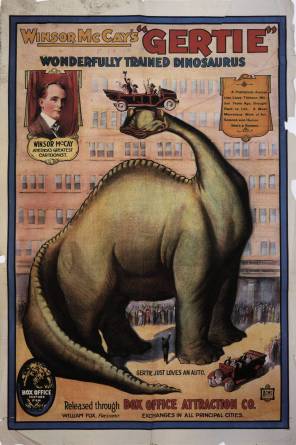 Directed, Produced, and Written by: Winsor McCay

Starring: Winsor McCay, George McManus, Roy McCardell, Max Fleischer, “Gertie the Dinosaur”
Tracing by: John A Fitzsimmons
Year: 1914
Remember that short animated film that featured in Jurassic Park? You know, the one where the science behind the creation of the dinosaurs in the film was explained to us by an anthropomorphic DNA strand? Well meet its inspiration, Gertie the Dinosaur.
You’ve probably seen pieces of this short film before. It’s a pretty iconic piece of animation that, nonetheless, a lot of people haven’t really fully seen. To be honest, I hadn’t seen any of the live action stuff up until this point, and I, too, didn’t really know the history behind any of it, but that’s kind of the point of me writing here: I learn along the way and hope to help you learn along with me!
Originally conceived as a vaudeville stage act, cartoonist and animator Winsor McCay’s original concept for Gertie involved him performing live on stage while the animation was projected. Much like John Hammond did with Mr. DNA in Jurassic Park, he would then interact with his dinosaur counterpart through careful timing.
McCay would issue Gertie commands, and the precocious dinosaur would seem to obey! McCay could even appear to toss Gertie an apple through sleight of hand. Then McCay would walk off stage, show up on screen, and ride Gertie offstage. I can’t imagine how amazing this must have seemed at the time, and, even today, would be pretty impressive thanks to the careful timing it would have required.
When McCay was approached by William Fox (whose name lives on in 20th Century Fox studios, etc.) to adapt the act to film, McCay added live action scenes to frame the animated sequence, creating a story about a bet he makes with fellow cartoonist George McManus that he could bring a “dinosaurus” back to life through the use of animation after they are inspired by a fossil display in a museum. After months of work, McCay presents his animated creation, Gertie, at a dinner gathering.
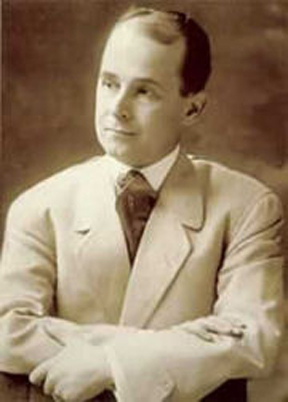
Winsor McCay, creator or Gertie as well as "Little Nemo"
Predating the widespread popularity of talkies, McCay’s interactions with Gertie are limited to the standard intertitles used in silent films. The film also predates cel animation, which allowed animators to save time and energy by layering the images on top of each other. McCay enlisted an art student, John A. Fitzsimmons, to assist him in the animation, and, together they redrew every detail of every frame of animation for the film on rice paper.
Though he didn’t have the convenience of cel animation at the time, McCay did pioneer the use of a technique that would later be called “key framing” — a technique that involves drawing two reference frames of animation, point A and point B, and then going back and drawing the frames that would go in between, creating a smooth, realistic sense of motion in even the most elaborate pieces of action. He also saved time through the use of cycling, or reusing frames of animation.
Gertie is widely recognized as the first animated character with a recognizable personality of her own. She’s stubborn and has an insatiable appetite, eating everything from trees to rocks. She’s easily distracted by her surroundings, is kind of a bully to her fellow prehistoric companions, and, when she’s scolded for her misbehavior, she sulks and cries like a child. Oh, and she loves music, which explains why she’s always swaying about happily when she’s not in full on dance mode!
Gertie paved the way for future animated stars, including Mickey Mouse, who wouldn’t make his first appearance for another 14 years! Though she suffered a sophomore slump in her second, incomplete film, Gertie on Tour, Gertie lives on as one of the most influential animated characters ever, and her debut short has gone on to be preserved in the National Film Registry, alongside classics like Gone with the Wind and Casablanca.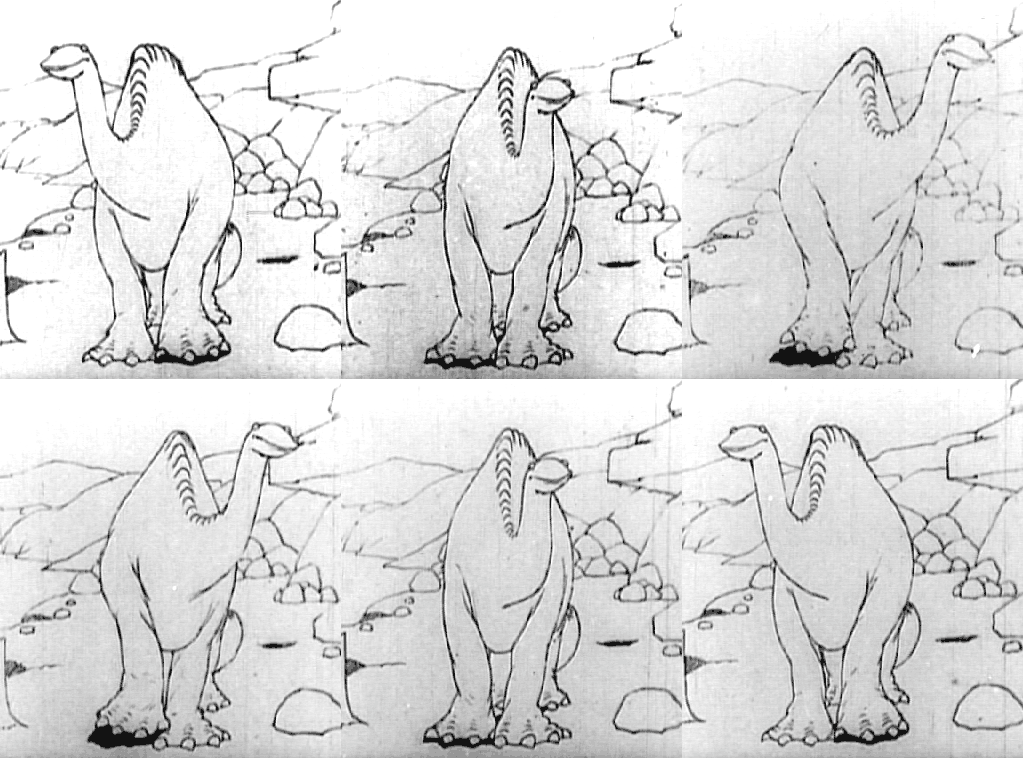

 The Viewer's Commentary