Archive
Short Film: “Gertie the Dinosaur,” The Grandmother of Jurassic Park
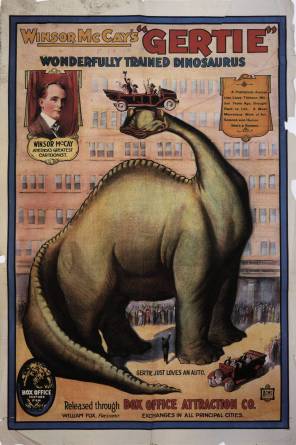 Directed, Produced, and Written by: Winsor McCay

Starring: Winsor McCay, George McManus, Roy McCardell, Max Fleischer, “Gertie the Dinosaur”
Tracing by: John A Fitzsimmons
Year: 1914
Remember that short animated film that featured in Jurassic Park? You know, the one where the science behind the creation of the dinosaurs in the film was explained to us by an anthropomorphic DNA strand? Well meet its inspiration, Gertie the Dinosaur.
You’ve probably seen pieces of this short film before. It’s a pretty iconic piece of animation that, nonetheless, a lot of people haven’t really fully seen. To be honest, I hadn’t seen any of the live action stuff up until this point, and I, too, didn’t really know the history behind any of it, but that’s kind of the point of me writing here: I learn along the way and hope to help you learn along with me!
Originally conceived as a vaudeville stage act, cartoonist and animator Winsor McCay’s original concept for Gertie involved him performing live on stage while the animation was projected. Much like John Hammond did with Mr. DNA in Jurassic Park, he would then interact with his dinosaur counterpart through careful timing.
McCay would issue Gertie commands, and the precocious dinosaur would seem to obey! McCay could even appear to toss Gertie an apple through sleight of hand. Then McCay would walk off stage, show up on screen, and ride Gertie offstage. I can’t imagine how amazing this must have seemed at the time, and, even today, would be pretty impressive thanks to the careful timing it would have required.
When McCay was approached by William Fox (whose name lives on in 20th Century Fox studios, etc.) to adapt the act to film, McCay added live action scenes to frame the animated sequence, creating a story about a bet he makes with fellow cartoonist George McManus that he could bring a “dinosaurus” back to life through the use of animation after they are inspired by a fossil display in a museum. After months of work, McCay presents his animated creation, Gertie, at a dinner gathering.
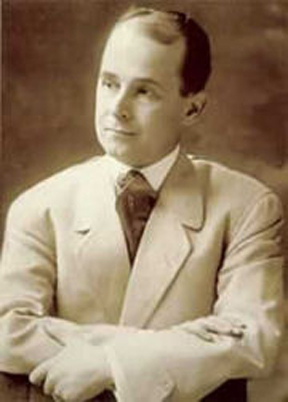
Winsor McCay, creator or Gertie as well as "Little Nemo"
Predating the widespread popularity of talkies, McCay’s interactions with Gertie are limited to the standard intertitles used in silent films. The film also predates cel animation, which allowed animators to save time and energy by layering the images on top of each other. McCay enlisted an art student, John A. Fitzsimmons, to assist him in the animation, and, together they redrew every detail of every frame of animation for the film on rice paper.
Though he didn’t have the convenience of cel animation at the time, McCay did pioneer the use of a technique that would later be called “key framing” — a technique that involves drawing two reference frames of animation, point A and point B, and then going back and drawing the frames that would go in between, creating a smooth, realistic sense of motion in even the most elaborate pieces of action. He also saved time through the use of cycling, or reusing frames of animation.
Gertie is widely recognized as the first animated character with a recognizable personality of her own. She’s stubborn and has an insatiable appetite, eating everything from trees to rocks. She’s easily distracted by her surroundings, is kind of a bully to her fellow prehistoric companions, and, when she’s scolded for her misbehavior, she sulks and cries like a child. Oh, and she loves music, which explains why she’s always swaying about happily when she’s not in full on dance mode!
Gertie paved the way for future animated stars, including Mickey Mouse, who wouldn’t make his first appearance for another 14 years! Though she suffered a sophomore slump in her second, incomplete film, Gertie on Tour, Gertie lives on as one of the most influential animated characters ever, and her debut short has gone on to be preserved in the National Film Registry, alongside classics like Gone with the Wind and Casablanca.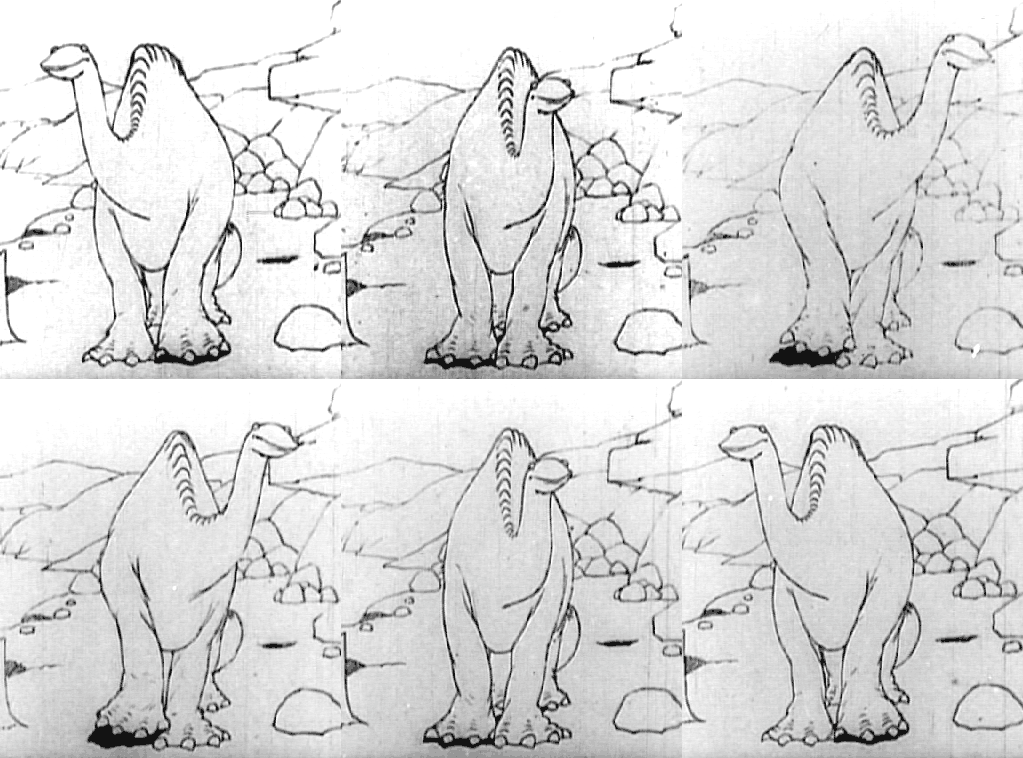

 The Viewer's Commentary